
Custer County Arrest Records and Charges
Arrest records in Custer County begin on the law-enforcement side. The Custer County Sheriff's Office enforces state and local law in unincorporated areas, operates the jail, serves court papers, maintains public order, and coordinates with other agencies. Sheriff Levi Maydole's office is the first official local contact for sheriff-held incident, booking, and jail records. Those records are not the same as the court charge record. They may show the arresting agency, event facts, custody status, and the request path for reports, but they do not by themselves prove a conviction.
Court charges after arrest begin when the prosecuting attorney reviews the facts and files a complaint, information, citation, or other charging document. Custer County criminal matters move through the Magistrate Division for misdemeanors, traffic matters, initial appearances, bond, and felony preliminary hearings. Felony cases that proceed are bound over to District Court. The filed charge record may show the charge name, statute, offense level, filing date, prosecutor, bond, next court date, and later charge status. The full case outcome belongs in the Custer County criminal court records file.
The official sheriff page in the manifest is shown at the Custer County Sheriff's Office source page.
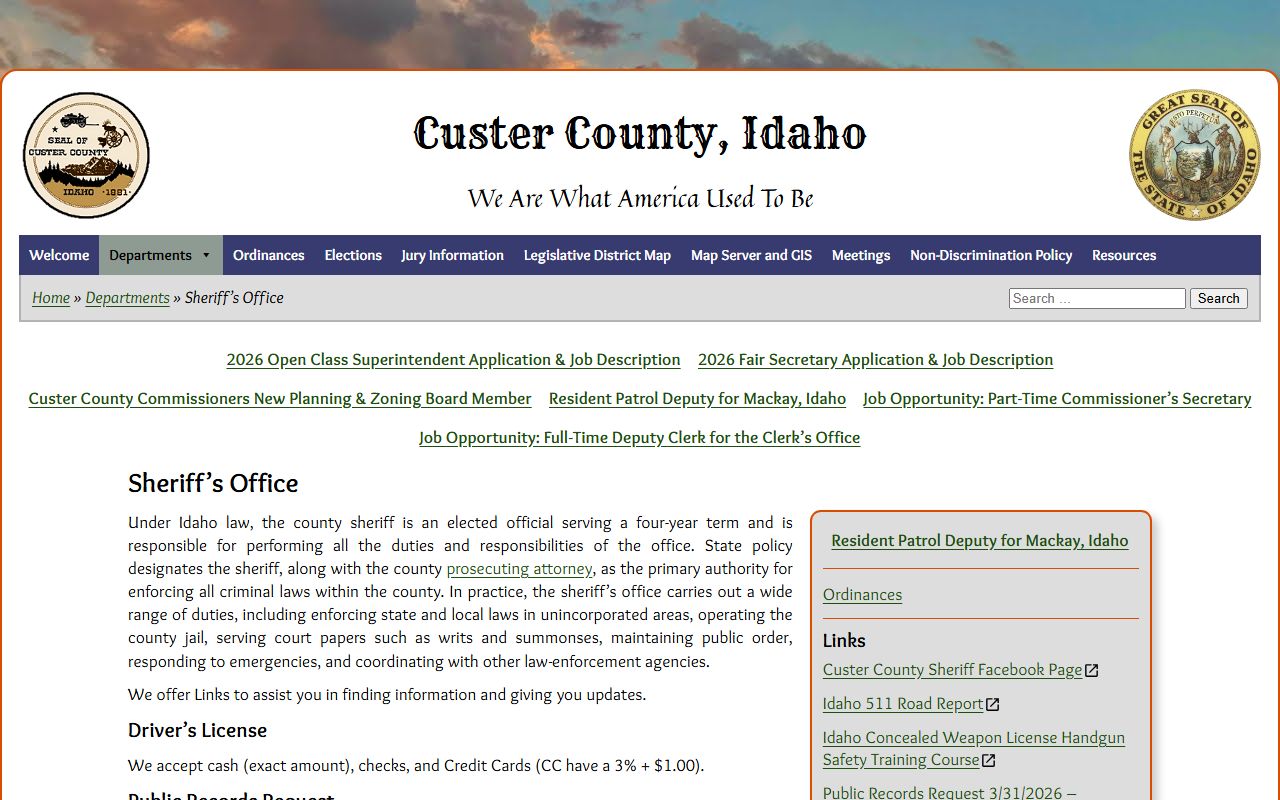
That sheriff source matters because arrest reports, jail records, service papers, and law-enforcement record requests are routed differently than filed court charges.
Search Custer County Court Charges
Custer County does not publish a separate county-built arrest-charge database. The court path runs through the statewide Idaho iCourt Portal, the Custer County Courts clerk, and courthouse access. The county courts page says proof of insurance, record requests, and general court inquiries may be emailed to custercourtclerks@custer.idcourts.gov. The court phone is (208) 879-2359. For a court charge lookup, a case number is the cleanest search key. A defendant name can work when the case number is not known, but name searches can return more than one person or more than one case.
- Start with the Custer County court page to confirm the local court contact and whether the matter is Magistrate Division or District Court.
- Open iCourt and use Smart Search for case status, party names, case numbers, filed charges, and public docket entries.
- Check Search Hearings if the immediate need is an arraignment, preliminary hearing, trial date, or review hearing.
- Use Make Payments only when the portal or clerk confirms the charge is eligible for online payment.
- Contact the Custer County Courts clerk for documents, certified copies, sealed-record questions, or records that do not display online.
Arrest or booking facts may not be in iCourt. If the search needs the sheriff report, jail custody detail, or a public-records response, use the sheriff request route instead of assuming the court portal has the law-enforcement file. Defendants in pending criminal cases have a special limit: the sheriff request form says they must use discovery rather than the public-records form to get case evidence.
Custer County Charging Documents
A charging document is the paper that turns an arrest, citation, or investigation into a court case. The Custer County Prosecuting Attorney, N. Paul Rogers, represents the state in criminal cases, reviews evidence, files charges, works with law enforcement, and prosecutes accused persons. His office is therefore the key bridge between sheriff arrest records and court charges after arrest. The court clerk keeps the filed case record after the charge is opened.
| Document | Who Uses It | What It Does | Custer County Context |
|---|---|---|---|
| Complaint | Prosecutor or charging authority | Starts many misdemeanor, infraction, or initial criminal matters. | Common in Magistrate Division cases, including traffic and misdemeanor charges. |
| Information | Prosecutor | States formal felony charges after preliminary proceedings or waiver. | Used when a felony moves from Magistrate Division to District Court. |
| Indictment | Grand jury process | Charges a case through grand-jury accusation. | Not shown as a routine local path in the research, but it remains a recognized charge form. |
The prosecutor office location page is included in the research source set, and the official prosecutor department page gives the local filing role. For charge questions tied to a pending court case, use the court clerk for record access and counsel for legal strategy. Victims in pending cases are encouraged by the sheriff request form to contact the prosecutor rather than using the sheriff records form for active case material.
Custer County Charge Status
A charge can change after it is filed. The first charge listed after an arrest may not be the final charge at plea, trial, dismissal, or sentencing. Idaho court records can show amendments, reductions, dismissal, transfer, bindover, and disposition. A Custer County charge search should therefore read each charge line with the case status and docket history, not just the first accusation that appears near the start of the case.
| Status | Meaning | Record Caution |
|---|---|---|
| Pending | The charge is active and has not reached final disposition. | Do not treat a pending charge as a conviction. |
| Amended | The filed charge changed by count, wording, statute, or level. | Check whether the original charge remains or was replaced. |
| Reduced | A more serious charge changed to a lesser offense. | The final judgment may differ from the arrest allegation. |
| Dismissed | The court ended the charge without a conviction on that count. | Look for whether dismissal was with or without prejudice. |
| Disposed | The charge reached an outcome, such as plea, trial result, or dismissal. | Read the disposition and sentence fields together. |
Note: iCourt may show public status and hearing data, but certified copies or hidden documents require the Custer County court clerk.
Custer County Charges vs Convictions
Charges and convictions are often confused in background searches. A charge is an allegation filed in court. A conviction is a final court result after a guilty plea, verdict, or other qualifying adjudication. Idaho Code 19-2604 can also affect how some records appear after eligible discharge, dismissal, or felony reduction relief. That relief is not a blanket deletion rule, and it does not erase every sheriff, prosecutor, BCI, IDOC, federal, or court record.
| Point | Charge | Conviction |
|---|---|---|
| Stage | Accusation filed after arrest, citation, or investigation. | Final guilt finding or plea entered by the court. |
| Proof | Based on probable cause or charging review. | Based on plea or proof beyond a reasonable doubt. |
| Where to Check | iCourt docket, clerk file, charging document. | Judgment, disposition, sentence, IDOC or BCI records when applicable. |
| Use Risk | May be amended, reduced, or dismissed. | May still require exact reading of sentence and later relief. |
For Custer County arrest records, this distinction is critical. A person can be arrested and never convicted. A person can also face several filed charges from one arrest, with only some charges resulting in conviction. Read the case event list, the final disposition, and any sentence order before drawing conclusions from an arrest or charge entry.
Sheriff Records After Arrest
The sheriff records channel is documented by the official Custer County Sheriff's Office public-records request form. The form requires requester information, contact data, a signature, Idaho resident declaration when applicable, preferred delivery method, and a narrative description of the record requested. A good arrest-record request should include date, time, location, full names, date of birth if known, and incident facts. Requests must be in writing, and fees or prepayment may apply before processing.
The sheriff office location shown in the image manifest comes from the official sheriff office location page.
The location source reinforces the main fallback route for arrest records that do not appear in iCourt: sheriff contact, written request, and verification with the originating agency.
| Request Item | What the Form Asks For |
|---|---|
| Requester details | Name, mailing address, telephone, email if applicable, and driver license information. |
| Delivery choice | Mail, pick-up, or email, with a warning that not all records qualify for electronic delivery. |
| Incident detail | Date, time, location, full names, date of birth if known, and record description. |
| Timing | Three working days for Idaho resident requests and twenty-one days for out-of-state requests, according to the form. |
| Limits | Exempt records, other-agency records on loan, pending case discovery, redaction, and copy labor rules. |
Custer County Charge Access Rules
Court charge records and sheriff arrest records use different legal frameworks. Judicial records are governed primarily by Idaho Court Administrative Rule 32. County, sheriff, and law-enforcement records use Idaho public-records rules, including Idaho Code 74-102 for the public right to examine records, Idaho Code 74-103 for response timing, and Idaho Code 74-104 for exemptions that include judicial records controlled by Supreme Court rules.
The sheriff public-records form also cites Idaho Code 74-120, which restricts use or distribution of public records for mailing or telephone lists. The manifest image for this statute source comes from the Idaho Code 74-120 official statute page.
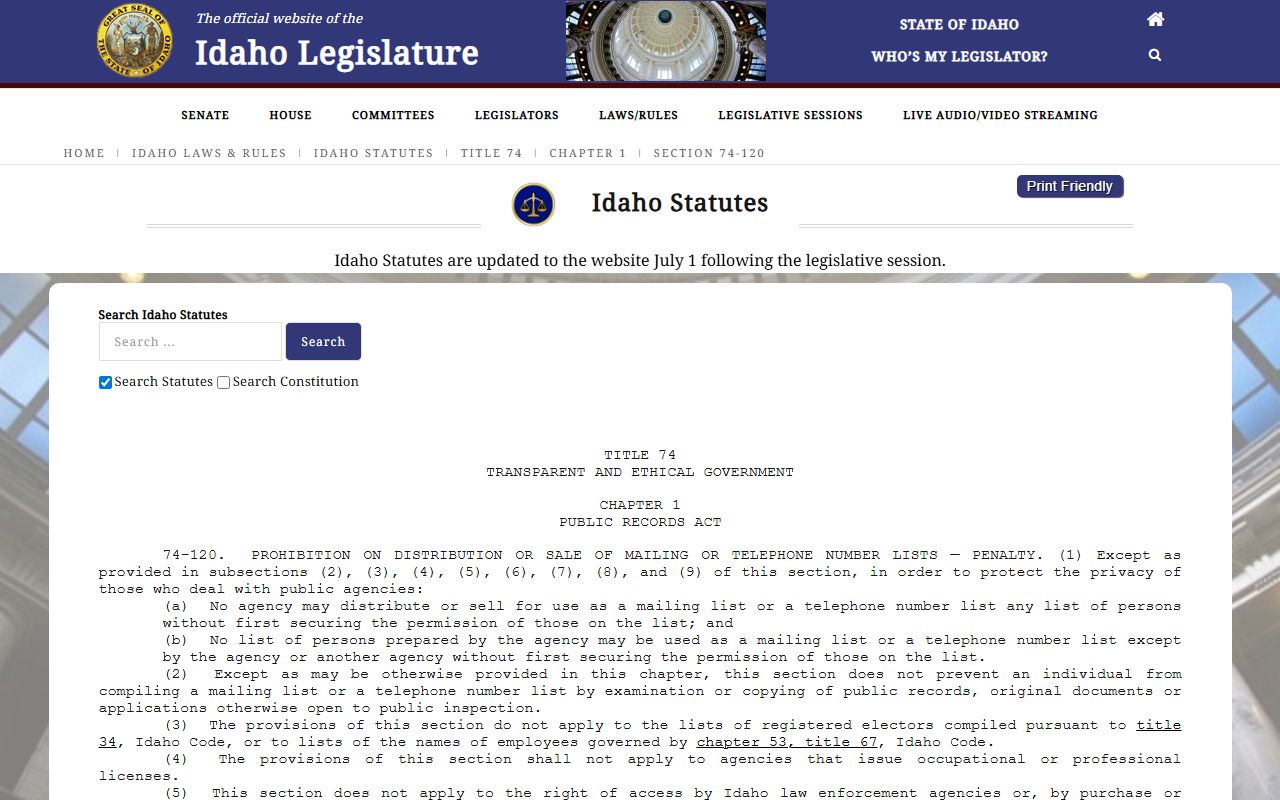
That statute is relevant because a lawful arrest-record request is still subject to use limits, redactions, and signed requester acknowledgements.
Restricted Custer County Charge Records
Not every arrest, charge, or warrant-linked item is public. iCourt says sealed cases and information exempt from disclosure by court order or ICAR 32 will not appear in public search results. Sealed case event entries are not visible to the public, although an order to seal that accompanies a sealed record may remain public. Juvenile matters, protected addresses, mental-health material, financial account data, minors' names, and some family or victim information may be withheld or redacted.
Law-enforcement files can also be limited. Active investigations, records borrowed from another agency, juvenile material, sealed warrants, and pending criminal case evidence may be withheld or routed elsewhere. For Custer County charge records, the practical rule is to separate the source before asking for the file: iCourt and the court clerk for filed court charges, sheriff written request for sheriff records, prosecutor or discovery for pending case evidence, and IDOC or Idaho State Police BCI for state custody or official criminal-history material.