
Custer County Criminal Court Files
A criminal court record begins when a charge is filed with the court. In Custer County, misdemeanors, traffic crimes, initial appearances, bond hearings, and preliminary felony hearings are handled in the Magistrate Division. Felony cases that move forward are transferred to District Court for arraignment, motions, plea, trial, disposition, and sentence. The local court page places both court levels in the Seventh Judicial District.
The criminal case file is distinct from an arrest report. Sheriff records may describe booking, custody, or an incident, but the court file shows formal charges, court dates, rulings, plea history, and final case results. For the arrest-to-charge path itself, the separate Custer County arrest records and court charges page explains prosecutor filing and charge status in more depth.
The Custer County prosecutor source identifies the office that reviews evidence and files charges.
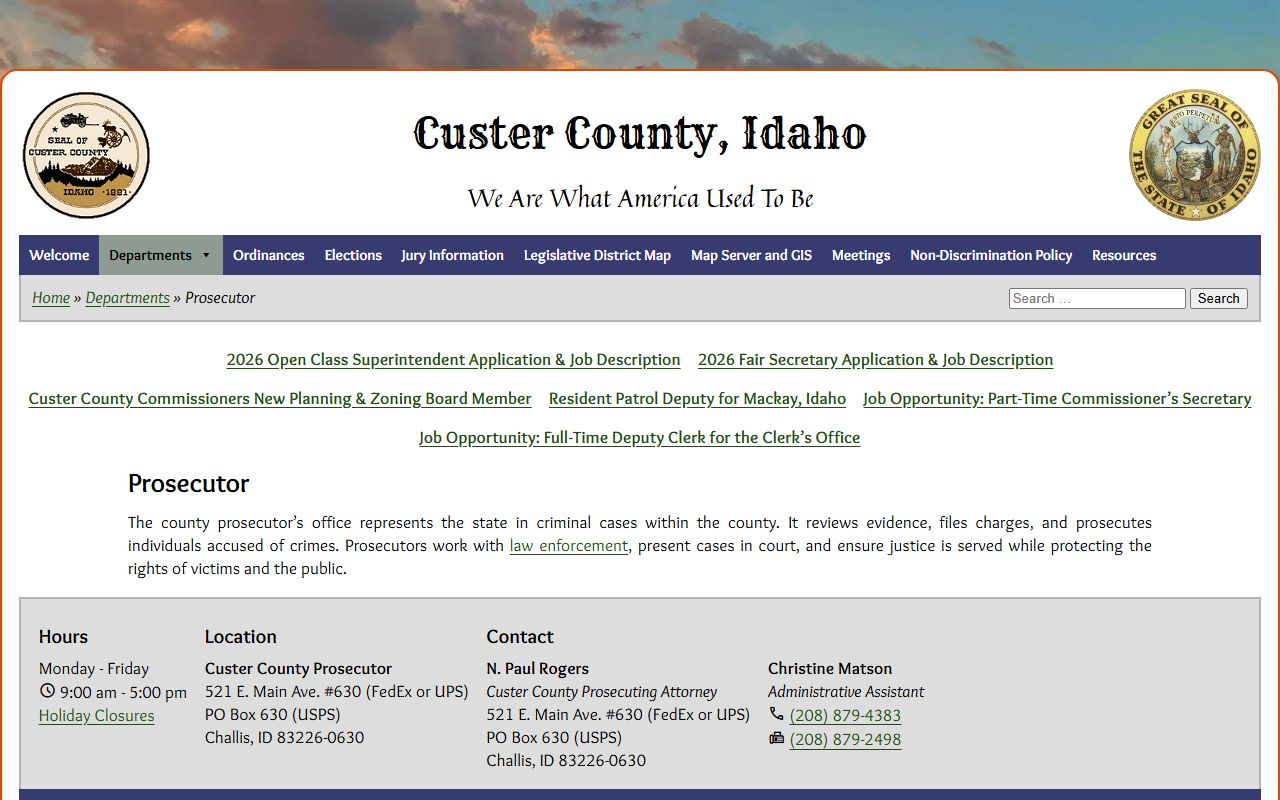
That prosecutor role is what turns a law-enforcement arrest into a filed criminal court case.
Search Custer County Criminal Records
The main public online route is the Idaho iCourt Portal. Use Smart Search for criminal case status, Search Hearings for court dates, and Make Payments for eligible criminal payments. Custer County does not publish a separate criminal case database. For documents, certified copies, or records not shown online, contact Custer County Courts at (208) 879-2359 or custercourtclerks@custer.idcourts.gov.
- Start with iCourt Smart Search and enter the case number if known.
- Use the defendant name when the case number is not available, then confirm county and court level.
- Read the docket entries for charges, hearing dates, bond events, pleas, motions, and disposition.
- Use Search Hearings when the immediate question is an upcoming arraignment, preliminary hearing, trial, or sentencing.
- Ask the Custer County court clerk for documents, certified copies, or older files not shown in the portal.
iCourt also warns that sealed cases and entries exempt under Idaho Court Administrative Rule 32 are not visible in public search results. A missing public criminal record may mean no public case was found, but it can also mean the record is restricted, sealed, juvenile, or held outside the public portal.
Custer County Criminal Case Flow
Criminal case movement depends on whether the charge is a misdemeanor or felony. Misdemeanors usually remain in the Magistrate Division. Felonies begin with initial proceedings and a preliminary hearing in the Magistrate Division. If the felony is bound over, the case moves to District Court for the main felony case.
Custer County's rural schedule can make hearing verification important. District Court is listed for the second Tuesday of each month, while Magistrate Court is held Mondays and Tuesdays. A public docket should be checked against the clerk if travel, bond, or appearance timing matters.
Case flow: Arrest or citation › Prosecutor review › Charges filed › Initial appearance › Bond and preliminary proceedings › Plea or trial › Disposition › Sentencing.
| Stage | Record created | Where to look |
|---|---|---|
| Initial appearance | First court setting, bond, rights advisement. | Magistrate Division docket. |
| Preliminary hearing | Probable-cause review for felony charges. | Magistrate Division docket. |
| Bindover | Transfer of felony to District Court. | Both magistrate and district records may matter. |
| Plea or trial | Guilty plea, trial verdict, dismissal, or acquittal. | District Court for felonies, Magistrate Court for misdemeanors. |
| Sentencing | Judgment, sentence, probation, fines, restitution. | Sentencing court and iCourt when public. |
Custer County Criminal Record Fields
A Custer County criminal court record may contain more than one charge, and each charge can have its own status. Read the charge line with the docket, disposition, and sentence. A criminal case can also include public defender appointment entries, prosecutor filings, bond changes, warrants for failure to appear, motions, orders, and payment events.
| Field | What it shows |
|---|---|
| Case number | The court identifier used in iCourt and clerk requests. |
| Defendant | The person accused in the criminal court case. |
| Charge | The filed allegation, statute, offense level, and count when public. |
| Bond | Release terms or financial bond entries if public. |
| Hearings | Arraignment, pretrial, preliminary hearing, trial, review, or sentencing dates. |
| Disposition | Dismissal, plea, conviction, acquittal, transfer, or closure. |
| Sentence | Jail, prison, probation, fines, costs, restitution, or other court orders. |
The Custer County prosecutor location source provides local office context for filed charges.
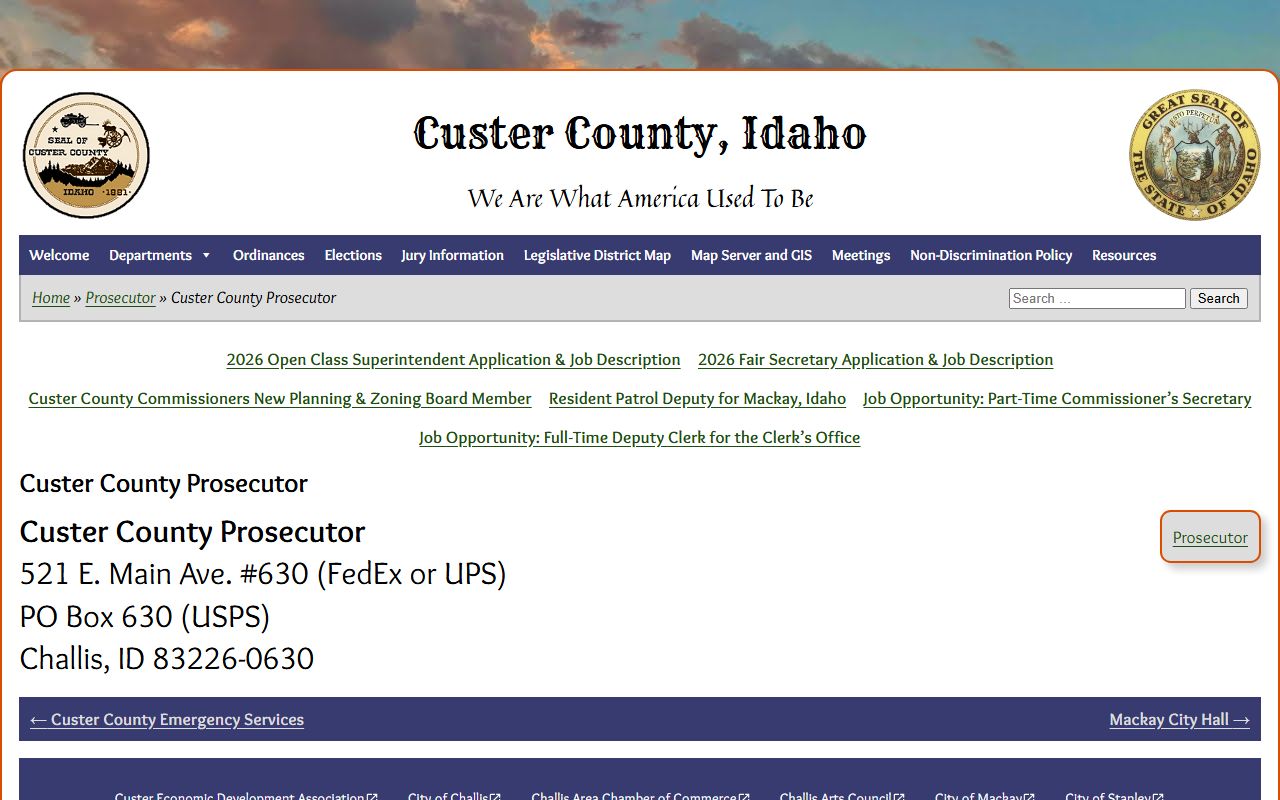
Prosecutor contact is not a substitute for the court clerk's record role, but it explains who files the criminal allegations.
Custer County Charges and Convictions
A charge is not the same as a conviction. A charge is an accusation filed by the prosecutor. A conviction is a final court result after a guilty plea, verdict, or other qualifying adjudication. Many Custer County case records must be read count by count because one charge may be dismissed while another results in conviction or sentence.
| Point | Charge | Conviction |
|---|---|---|
| Meaning | Filed allegation. | Final guilt finding or plea. |
| Timing | Early or amended during case. | At disposition or sentencing. |
| Risk | May be reduced, amended, or dismissed. | May still be affected by later Idaho relief. |
| Record check | Charging document and docket. | Judgment, sentence, disposition, IDOC or BCI where applicable. |
Idaho State Police Bureau of Criminal Identification is separate from the court record. It handles official criminal-history and identification services. The court record tells what happened in the Custer County case, while BCI records and IDOC records may show broader state criminal-history or custody data.
The Idaho State Police source and BCI source appear in the research as state-level criminal-history routes.
State police records should not be confused with the Custer County court file maintained by the judicial branch.
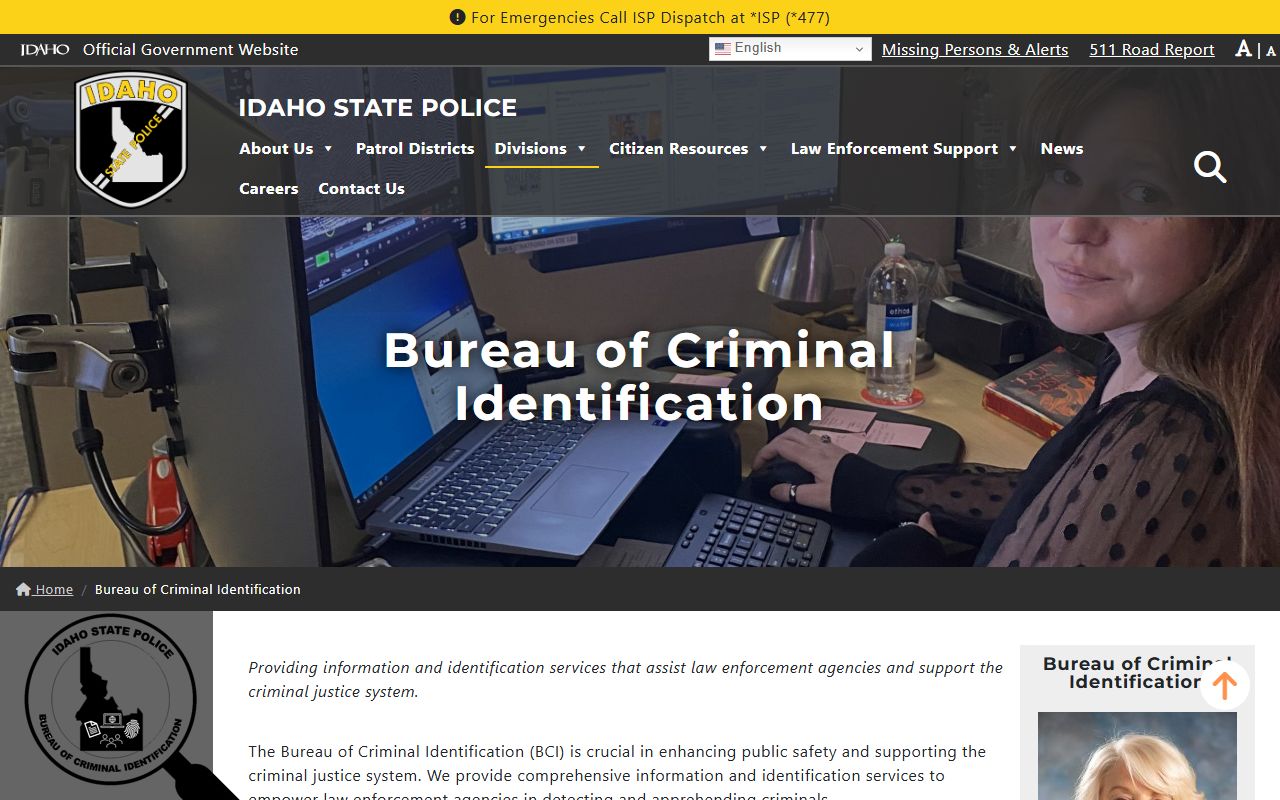
BCI can be relevant for formal criminal-history checks, but iCourt and the Custer clerk remain the court-record path.
Sealed Custer County Criminal Records
Idaho Court Administrative Rule 32 controls judicial-record access. Juvenile records, sealed cases, sealed entries, protected addresses, victim data, Social Security numbers, financial account data, and other confidential material may be unavailable to the public. iCourt states that sealed entries do not appear in public search results. An order to seal may still appear while the sealed content stays closed.
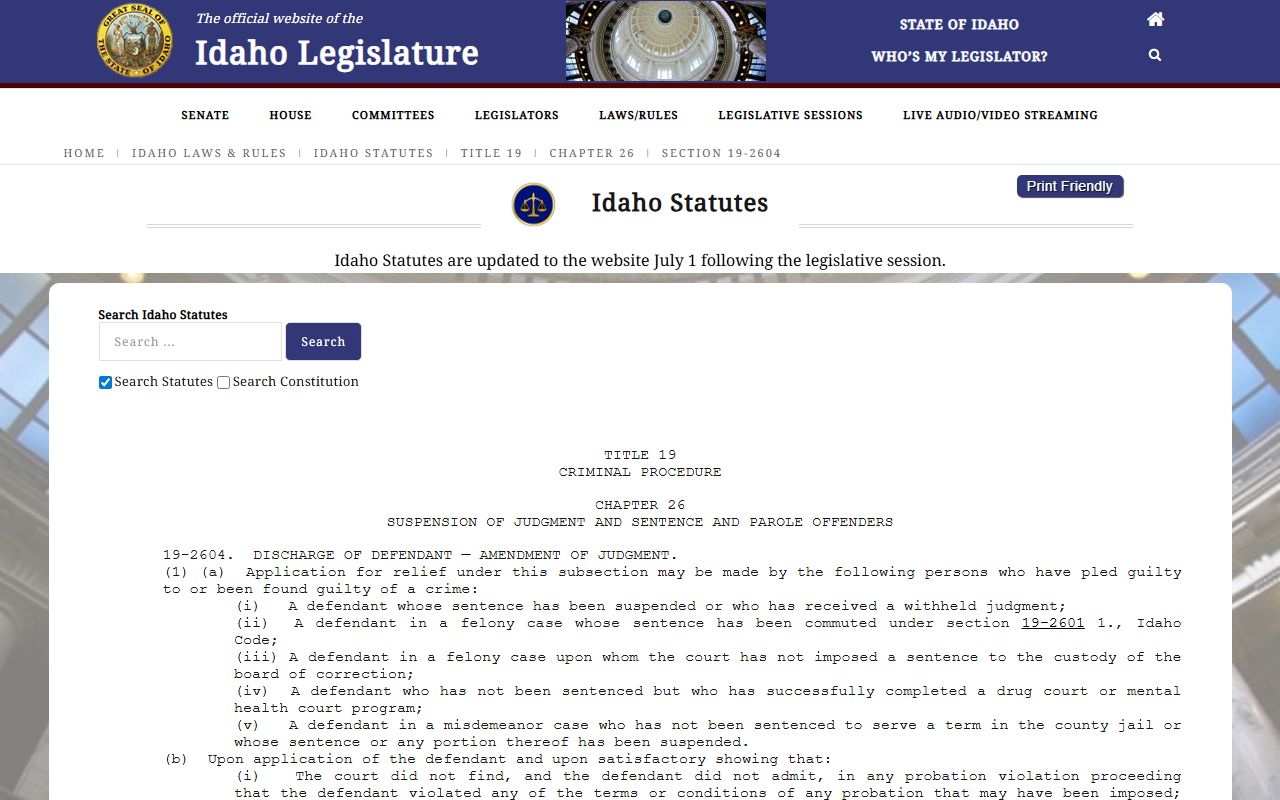
Idaho Code 19-2604 may allow discharge, dismissal, or felony reduction relief in eligible cases. It is not a blanket expungement law. A granted order may change how the court record reads, but sheriff, prosecutor, BCI, federal, or IDOC records may still have separate legal treatment.
The Idaho Code 19-2604 source is the relief statute identified in the research.
Criminal defendants should consider counsel before seeking relief or relying on a public-record interpretation.
Custer County Defense Access
Idaho public defense is now handled through the State Public Defender system. The Seventh Judicial District includes Custer County, and the research identifies Jordan Crane as District Public Defender for the district. Public defender information may appear in criminal court records when counsel is appointed, but eligibility and representation questions are not resolved through a public record search.
Pending defendants should note the sheriff public-records form limit. The form says defendants in pending criminal cases must use discovery, not the sheriff public-records request form, to get evidence. That means a criminal court record search can identify the case and hearing schedule, while police reports, video, and prosecution evidence follow criminal procedure.
The prosecutor page also directs victims in pending criminal cases toward the prosecutor rather than the sheriff records process. This keeps the court file, prosecutor case work, defense discovery, and sheriff public-records functions from being treated as one interchangeable record system.
The Idaho State Public Defender source explains the statewide public defense agency.
For pending cases, defendants use discovery and court procedure rather than sheriff public-record requests for case evidence.